

How to identify early signs of frailty: A practical guide for professionals
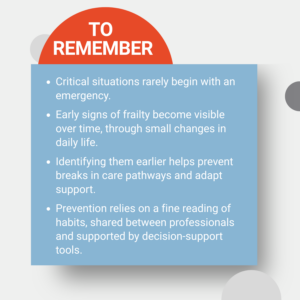
In the field, critical situations rarely begin with an emergency.
They develop gradually, through changes that are often subtle and difficult to perceive in everyday life: a shift in daily routines, evolving habits, a gradual decrease in activity.
For healthcare, care coordination and telecare professionals, the question is therefore not whether prevention is necessary, but how to identify these signals earlier—before they become problematic.
This is the core challenge of identifying early signs of frailty.
What do we mean by “early signs” of frailty?
A practical definition
Early signs among older adults are early, often discreet indicators of a change in a person’s situation.
They are neither emergency alerts nor confirmed incidents. They unfold over time and only become meaningful when observed in relation to usual daily habits.
These signs are particularly difficult to detect because they are rarely verbalised by the person themselves. Instead, they appear as small variations in daily life, revealing a gradual process of frailty.
Concrete examples observed in the field
In professional practice, the most commonly observed early signs include:
- more frequent or unusual night-time awakenings,
- a gradual decrease in daily activity,
- changes in sleep–wake rhythms,
- a tendency to stay at home more often,
- changes in eating habits,
- behavioural changes linked to medication or fatigue.
Taken individually, these elements may seem insignificant.
Observed over time, however, they become valuable indicators of frailty particularly within a prevention-focused approach to loss of autonomy.
Why identifying them before an emergency makes all the difference
Emergencies are often consequences, not starting points
When a situation becomes critical, it is often the result of an accumulation of signals that were not identified or interpreted in time.
Falls, unplanned hospital admissions, breakdowns in home support—these events rarely occur without warning signs.
Field experience shows that identifying early signs makes it possible to understand what is changing, before the situation deteriorates and requires heavier interventions.
Prevention as a lever for quality support
Identifying early signs upstream is a key lever for preventing loss of autonomy, particularly in home support and long-term care settings.
This approach makes it possible to:
- adapt support earlier,
- engage in dialogue with the person and their relatives,
- better coordinate actions between professionals,
- avoid late and more complex interventions.
Prevention is not about increased monitoring.
It is about reading everyday life more carefully, in order to act with discernment before situations deteriorate.
How to identify early signs in professional practice
Human observation remains essential
Professionals have a crucial asset: their in-depth knowledge of the people they support.
Exchanges, visits, perceptions and observation of daily habits form the foundation of early sign detection.
This human expertise makes it possible to identify what “no longer looks like usual”, even when nothing has yet been formalised.
The limits of observation alone
However, human observation faces well-known limitations:
- professionals are not continuously present,
- information is often fragmented between different stakeholders,
- gradual changes are difficult to perceive without perspective.
In this context, identifying early signs often requires better coordination, so that information can circulate between healthcare, support and telecare professionals and be interpreted collectively.
The role of tools and technologies in identifying early signs
Making everyday life observable—without distorting it
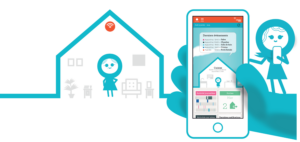
Certain telemonitoring solutions designed for professionals can help objectify changes in daily life: activity levels, daily rhythms, night-time habits or presence at home.
These tools provide continuity of information over time, making it possible to identify deviations from usual patterns where occasional observation is no longer sufficient.
Informing, not deciding, in place of professionals
One essential point must be emphasised:
tools are not designed to trigger constant alerts, nor to replace professional expertise.
The information produced by these tools:
- sheds light on situations,
- provides context,
- highlights meaningful changes.
Decision-making always remains human.
It is the professional who interprets the information, cross-checks it and decides on appropriate actions, in coordination with other stakeholders.
Field feedback
As part of reinforced home support, activity data revealed repeated night-time awakenings in a person living alone.
These events, occurring during the night, were unknown to both family members and professionals.
Thanks to this information, discussions could take place with the person and their relatives. It emerged that these awakenings were linked to a recent change in medication.
This awareness made it possible to alert the physician and adjust the care plan, preventing a further deterioration of the situation.
Without this fine-grained reading of everyday life, these signals would have remained invisible.
Professionals and tools: an essential complementarity
Identifying early signs relies on a close articulation between:
- human expertise,
- continuity of information,
- coordination between stakeholders.
Tools provide visibility over time.
Professionals provide meaning, analysis and decision-making.
It is this complementarity that makes it possible to act at the right time, in a proportionate and appropriate way, in support of prevention and quality of care.
Conclusion
Identifying early signs of frailty is, above all, about adopting a different way of reading everyday life.
A more attentive, continuous reading, shared between all those involved in support and care.
It is with this approach in mind that Telegrafik’s platforms and solutions have been designed: to support professionals in this fine-grained understanding of situations, by providing useful information—without ever replacing their expertise.
Acting earlier means giving professionals the means to support people better, together.