
Telegrafik – Hello Valérie Bernard, you are a hospital biographer in an EHPAD (Nursing Home) and a Palliative Care Unit (USP) in Toulouse. What exactly does this profession involve?
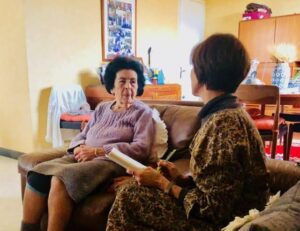
Valérie Bernard – Hospital biography is a relatively new approach (in existence for about fifteen years) that involves offering seriously ill people, who are being cared for and supported in palliative care, at-home hospitalization (HAD), or in an EHPAD, the opportunity to write the book of their life with the help of a trained hospital biographer. These individuals are invited to recount their story, to express their memories, their emotions, and then, at the end of the interviews, they (or a designated loved one) receive their story free of charge in the form of a unique book bound by an artisan d’art (master craftsman).
Telegrafik – How is this approach offered to the person?
Valérie Bernard –The offer is made by a member of the care team. Indeed, this is not a hobby, but a genuine accompanying care, which allows the person to invest in a new project, to get moving again through the narrative, and to return to themselves. By recounting their story, the patient can revisit it and give it new meaning. And also, to transmit it to their loved ones, and recreate connection.
For the caregivers, the hospital biography strengthens cohesion around a humanistic and holistic project. The presentation of the book, which often takes place within the establishment, is an opportunity for the team to support bereaved loved ones and to restore value and singularity to their work. It’s always a beautiful moment of sharing.

Telegrafik – Does this service cost anything?
Valérie Bernard – For the patient, the service is entirely free, because we want it to be accessible to everyone. However, since biographers are professionals, trained for this purpose, they are paid, and rely on private patronage, calls for projects, and the establishments, when they can, provide supplementary funding.
Telegrafik – And in an EHPAD, how is this process structured?
Valérie Bernard – In an EHPAD, the process is identical, and the offer is also made by a member of the care team. We often benefit from a little more time than in a Palliative Care Unit, which allows the person to be able to read their book, keep it, or offer it directly to their loved ones. We usually suggest between five and six interviews to the resident, depending on their state of health, which allows for a beautiful work to be written. Our goal is always to stay true to the person’s melody, transcribe their tone, their language habits, and their expressions. Attention to the paraverbal is also essential in order to translate the emotion shared during this meeting time. The hospital biographer, therefore, takes great care in the layout of the narrative.
Telegrafik – A small concluding remark?
Valérie Bernard – I will just finish by quoting Paul Ricoeur: “To invite the other to tell their story is to invite them to give meaning, coherence, and unity to their life.”
Valérie Bernard founded the association Notes de vie (https://www.notesdevie.org/)
Audio interview link:
Video links:
https://www.notesdevie.org/revue-de-presse/notes-de-vie-lassociation-reportage-france-3/
https://www.notesdevie.org/revue-de-presse/notes-de-vie-lassociation-migso/