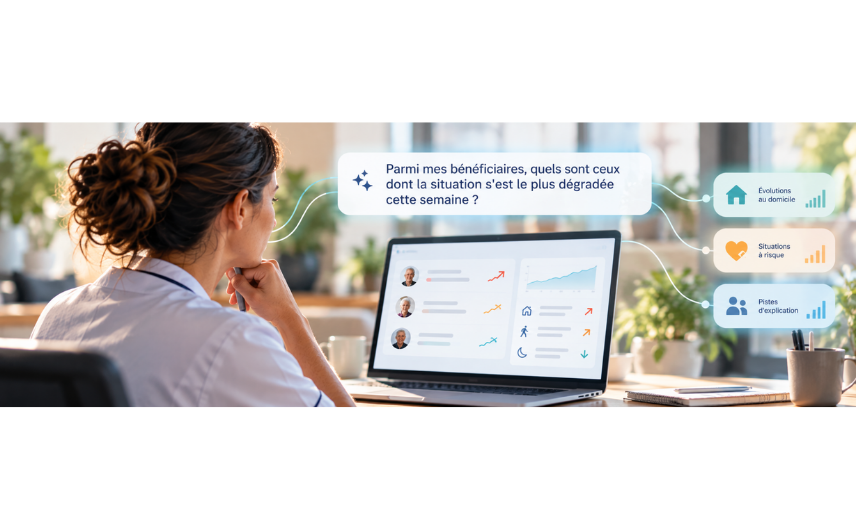
Tomorrow, a care coordinator nurse might ask this exact question directly to her monitoring tool. Artificial intelligence would analyze the available data, highlight significant changes, and suggest potential explanations. It would then be up to the professional to cross-reference these insights with her own personal knowledge of the patients and decide on the best course of action.
This shift captures the core transformation taking place across the senior care sector: AI shouldn’t just be about analyzing more data. Above all, it should help professionals instantly access the information they actually need.
The key question is no longer “How far can we automate without losing the human touch?”, but rather: What can we delegate to machines so professionals can make the absolute best use of their expertise?
From Prevention to Care Delivery: Where Does AI Fit in Healthcare?
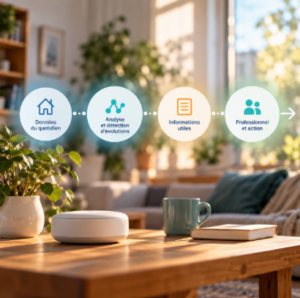
Artificial intelligence is gradually stepping into various stages of the healthcare journey.
When it comes to prevention and screening, it can analyze large volumes of data to identify anomalies or pinpoint higher-risk populations. It can also help better understand a situation by bringing together multiple pieces of information, and subsequently contribute to improving care delivery by getting useful, actionable information to professionals faster.
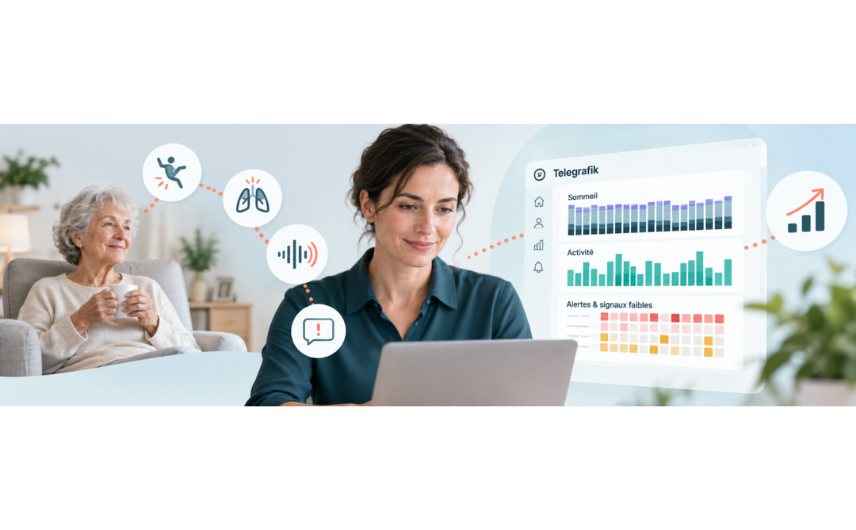
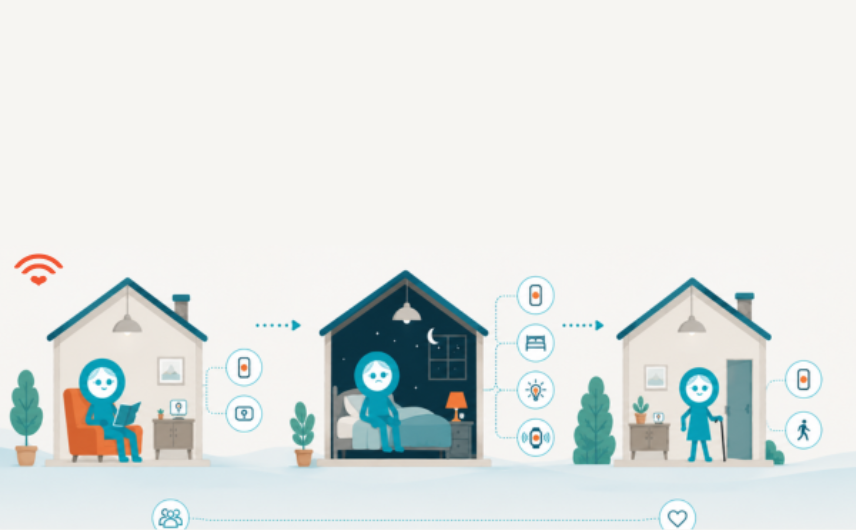
In the healthy aging sector, these applications are already taking shape. Remote monitoring solutions can, for example, analyze certain data related to an elderly person’s activity, sleep, or daily routine at home in order to surface trends that merit the care team’s attention.
The machine’s ability to process massive amounts of data opens up new possibilities.
However, in healthcare, performance alone is not enough: information reliability, clear awareness of the tool’s limitations, and human supervision remain essential.
Automating Analysis, Not the Professional’s Expertise
Processing thousands of data points, flagging an anomaly, correlating disparate information, or identifying situations that require special attention—these are all tasks where AI can bring real value.
Yet, a single data point never tells the full story of an individual’s situation.
The professional understands their personal history, environment, level of independence, real-world observations from the field, and insights shared by relatives or other caregivers. This rich context is what enables them to interpret the information, exercise judgment, and decide on the best course of action.
The distribution of roles could thus evolve: delegating more analysis to the machine so that professionals can concentrate their expertise on interpretation and decision-making.
This is what Carole Zisa-Garat, CEO of Telegrafik, refers to as the “augmented professional”: not a worker progressively replaced by technology, but one who is less overburdened by information, more clear-headed, and better equipped to make decisions. This vision was at the heart of her speech at the MEDEF REF Santé conference.
Tomorrow: Consulting Data Less, Interrogating It More?
This shift could also transform the day-to-day way professionals interact with their tools.
Today, they review dashboards, graphs, indicators, and alerts. Tomorrow, AI could allow them to query all of that information directly based on their specific need.
A coordinating nurse could, for instance, ask:
“Among my care recipients, whose situation has deteriorated the most this week?”
This feature is already being envisioned at Telegrafik. The AI analyzes available data, identifies meaningful developments, and highlights factors to aid understanding.
This evolution also reshapes how we measure the performance of artificial intelligence. Its value no longer lies in producing ever-increasing volumes of information, indicators, or alerts, but in its ability to reduce cognitive and informational load and bring to light what truly deserves attention.
What If Automation was Primarily About Freeing Up Time?
In the care and support professions, searching for information, cross-referencing multiple data points, or switching between tools takes time.

The stakes of automation are therefore very concrete: taking on a portion of this analysis and research work to give time and availability back to the professional.
This also assumes that AI integrates seamlessly into existing practices. Adding a new interface, new alerts, or more data to review would, on the contrary, risk adding to the teams’ daily workload.
For stakeholders in the healthy aging sector, the challenge is not about determining how far AI can replace human intervention. It is about understanding where it can be genuinely useful to better support professionals and individuals.
Because even as analytical and prioritization capabilities continue to advance, understanding a situation in all its complexity, exercising judgment, building relationships, and making decisions remain at the core of the care and support professions. This is perhaps where the true promise of the augmented professional lies: leveraging the power of technology more effectively in order to dedicate more time to what deeply requires the human touch.