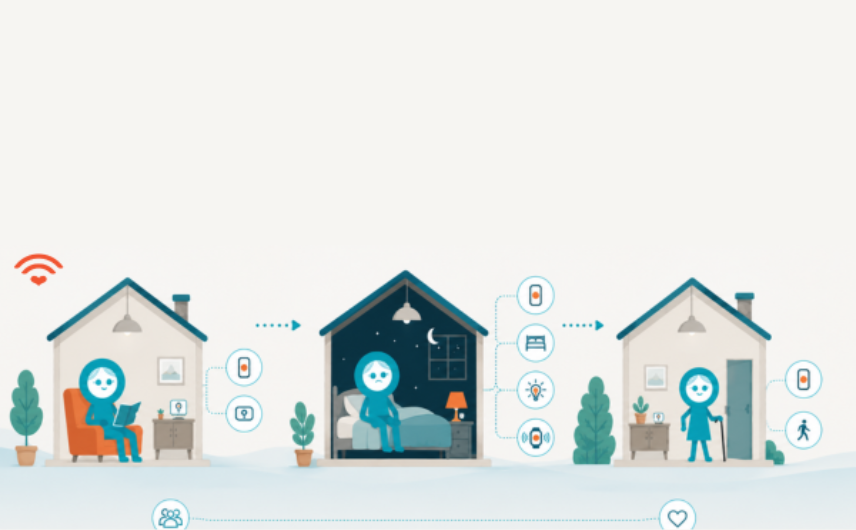

Some occur suddenly and may require a rapid response: a fall, respiratory distress, or an unusual event. Others set in gradually: a person goes out less, their sleep patterns change, or their activity at home evolves over the weeks.
The technologies used for reinforced home care are evolving today to address both of these timeframes: better detecting certain events as they occur and making long-term evolutions more visible.
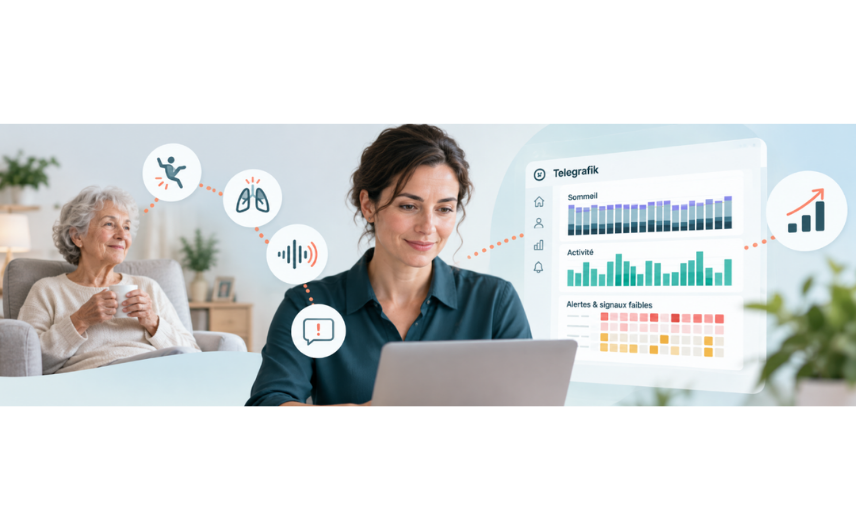
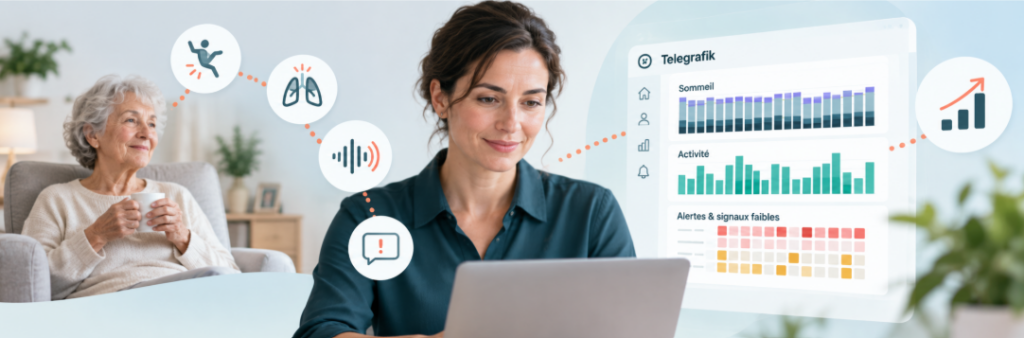
AI-powered sound environment analysis, lifestyle visualization, and tracking of alerts and weak signals: how can these new possibilities help care managers and CRT coordinators better understand the situations they oversee?
Expanding Detection and Observation Capabilities
Telecare solutions already provide CRT teams with complementary information on what happens between two interventions: home activity, sleep, outings, or the detection of specific events.
Today, new technologies allow us to go further, enriching both the types of events that can be detected and the way evolutions are observed over time.
The challenge is not to multiply the available data, but to diversify useful information and make it easier for professionals to interpret.
It is with this in mind that Telegrafik is enhancing its solutions with new detection and analysis capabilities.
Sound Analysis to Identify New At-Risk Situations
Sound is a complementary source of information for identifying certain events occurring in the home.
Telegrafik is therefore working to deploy AI-based sound environment analysis technologies for its users.
This technology can notably identify events such as choking, respiratory distress, vomiting, abnormal noises, or certain sounds associated with a fall.
Its value lies particularly in its ability to detect certain situations without requiring any voluntary action from the beneficiary. It thus complements the other security and telecare devices available.
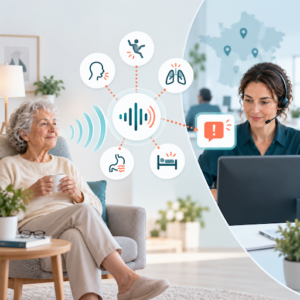
For CRT teams, this new source of information expands the range of situations that can be spotted when they occur at home.
Sound analysis thus illustrates new potential uses of artificial intelligence in elderly care. It complements the AI applications already used to analyze data from telecare devices and highlight information that requires professional attention.
Advanced Charts to Make Long-Term Evolutions Visible
Alongside events that need to be detected the moment they occur, other changes only make sense when observed over a longer period.
A person may gradually go out less often, spend more time in bed, or experience changes in their sleep rhythm. Taken in isolation, these changes do not necessarily lead to a conclusion. However, their repetition or establishment over time can provide useful information for care teams.
Telegrafik is therefore also enriching its platform with new charts allowing professionals to visualize the evolution of lifestyle habits over several weeks or months.
Teams can specifically track time spent in bed and its distribution between day and night. Sleep-related data also makes it possible to visualize the different phases: deep sleep, REM sleep, light sleep, and awake periods, as well as their evolution over time.
The same logic applies to daily activity. Professionals can observe the time spent in different rooms of the house, time spent outside, or doorways crossed, and track their evolution over the selected period.
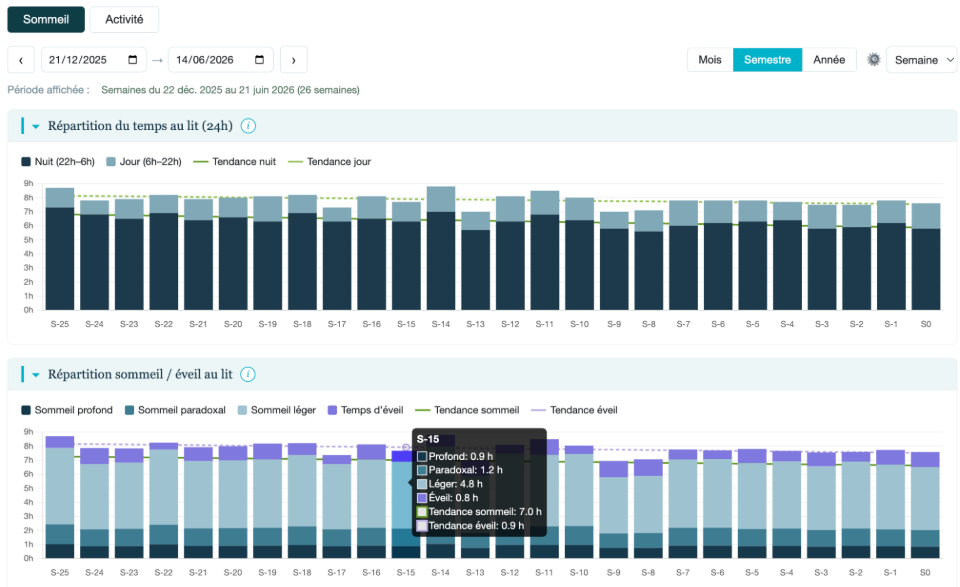
Examples of visualizing a beneficiary’s sleep and activity evolution over several weeks on the Telegrafik platform.
The goal is not to add an extra piece of data to a given day, but to allow professionals to step back and more easily visualize a trend.
Bridging Alerts and Weak Signals to Better Understand a Situation
This longitudinal view takes on another dimension when different pieces of information can be cross-referenced.
The new monitoring screens make it possible to visualize, over the same period, immediate alerts — activity anomalies, getting out of bed, pressing the emergency pendant, or fall detections — alongside various weak signals, such as a drop in activity or outings, sleep disturbances, a decrease in time spent outside the bedroom, or certain changes in habits.
Events that required an intervention can also be identified.
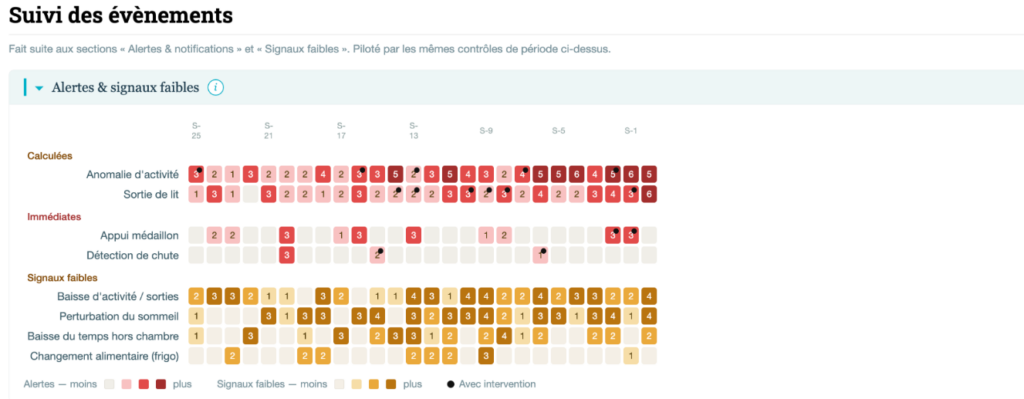
Long-term tracking of alerts and weak signals detected for a beneficiary.
For a care manager or a CRT coordinator, this perspective helps place an event into a broader context.
A decrease in outings, for example, does not necessarily mean something when observed occasionally. But if it persists over time and is accompanied by a change in sleep or home activity, combining this information might prompt the professional to look at the situation more closely.
We thus move from a succession of isolated data points to a more comprehensive view of the beneficiary’s evolution.
Technology Makes it Visible, Professionals Give it Meaning
A change in sleep, a decrease in outings, or a sound event can have multiple explanations.
This information makes sense when cross-referenced with what the teams already know about the beneficiary: their general health, level of autonomy, environment, observations made at home, reports from other caregivers, or conversations with family members.
Technology can detect, objectify, and make things visible. The professional remains the one who gives meaning to the information and decides on the next steps.
For CRTs, these new technologies offer two complementary possibilities: expanding the range of detectable situations and better understanding long-term evolutions.
It is with this mindset that Telegrafik continues to evolve its solutions : not to multiply data or equipment, but to provide CRT teams with more easily actionable information in caring for their beneficiaries.